Daily Summary
Today's AI landscape is marked by explosive economic growth, with Nvidia reporting record profits driven by surging AI chip demand and projections for $700 billion in AI data center spending this year. Simultaneously, geopolitical tensions are rising as the Pentagon issues an ultimatum to Anthropic over AI model usage restrictions, while malicious actors are increasingly leveraging AI for disruptive activities. Amidst these developments, AI capabilities continue to advance with Google's Gemini enabling multi-step task automation and researchers developing methods to double LLM training speed.
Top Stories

OpenAI has released its latest threat report, detailing how malicious actors are increasingly combining AI models with existing internet infrastructure like websites and social platforms to amplify disruptive activities. The report emphasizes the evolving challenges in detecting and defending against these sophisticated, AI-enhanced threats.
- •The report focuses on how malicious actors integrate AI models with readily available online tools and platforms.
- •It highlights the growing complexity of identifying and mitigating AI-driven disinformation and other harmful uses.
- •OpenAI's findings aim to inform better detection strategies and defense mechanisms against these emerging threats.
- •The report was released in February 2026, indicating a continuous monitoring of the threat landscape.
This report is crucial for the AI industry as it underscores the urgent need for robust safety protocols and ethical AI development to counteract malicious applications. Understanding these threats is vital for building resilient AI systems and protecting digital ecosystems.

Nvidia has announced a staggering $43 billion in quarterly profit, contributing to an annual profit of $120 billion, largely propelled by the insatiable demand for its AI chips. This monumental growth solidifies Nvidia's dominant position in the rapidly expanding artificial intelligence hardware market.
- •Nvidia's quarterly profit reached an unprecedented $43 billion.
- •The company's total profit for the fiscal year soared to $120 billion.
- •This represents a dramatic increase from just $4.4 billion in annual profit three years prior.
- •The growth is primarily attributed to strong sales of its specialized chips essential for AI development and deployment.
Nvidia's record-breaking profits highlight the immense financial investment and rapid expansion occurring within the AI sector, particularly in foundational hardware. This indicates the critical bottleneck and immense value placed on high-performance computing necessary for advancing AI capabilities globally.
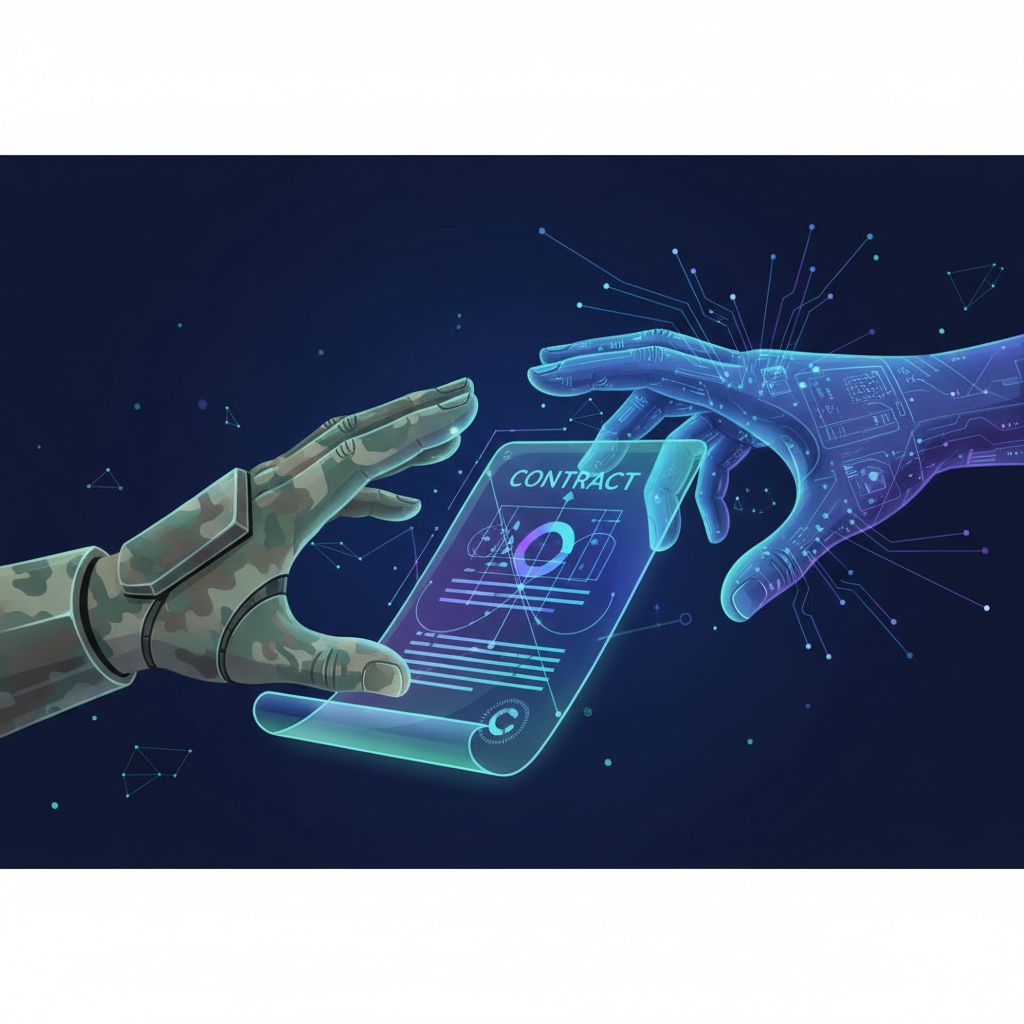
The Pentagon has issued an ultimatum to AI developer Anthropic, demanding that the company lift restrictions on how its AI models can be utilized, particularly for military applications. Failure to comply could result in Anthropic being designated a supply chain risk, impacting its ability to work with government entities.
- •The Pentagon is challenging Anthropic's self-imposed limitations on its AI model's usage.
- •Anthropic's stance on ethical AI use has created a conflict with military requirements.
- •The ultimatum suggests that non-compliance could lead to Anthropic being labeled a 'supply chain risk'.
- •This designation would likely hinder Anthropic's opportunities for government contracts and partnerships.
This conflict highlights the growing tension between AI developers' ethical guidelines and national security interests, forcing a critical discussion on the responsible deployment of powerful AI. It sets a precedent for how governments will interact with AI companies regarding sensitive applications and intellectual property control.
All Updates
Tech Breakthroughs
3 items
Researchers developed a new method leveraging idle computing time to double LLM training speed while maintaining accuracy.
PhysiOpt system combines generative AI with physics simulations to create durable, real-world 3D printable accessories and decor.
An AI-driven method provides holistic cell information to help researchers better understand disease mechanisms and plan experiments in cell biology.
Research Papers
1 item
OpenAI's latest threat report details how malicious actors combine AI models with websites and social platforms for disruption.
Product Launches
10 items
Google's Gemini AI assistant on Android now automates multi-step tasks like rideshare, grocery, or food delivery requests.
Google's Gemini AI will enable multistep tasks like ordering food or hailing a car on Pixel 10 and Galaxy S26 phones.
Google Gemini AI can now prepare rideshare or grocery orders on Pixel 10 and Galaxy S26, enhancing its assistant capabilities.
Samsung Galaxy S26 devices will integrate Android’s latest AI features, showcased at Samsung Unpacked 2026.
Amazon allows users to customize Alexa’s AI personality to be more friendly, blunt, or chilled out during conversations.
Adobe launches Quick Cut, a new Firefly AI tool that automatically stitches video clips into a first draft to help editors focus on storytelling.
Google's Gemini can now automate tasks like booking Uber rides or ordering DoorDash meals directly from phones, starting with Samsung Galaxy S26.
CUDIS launches a new health ring line featuring an AI-fueled 'coach' that incentivizes healthy behavior with redeemable points.
Google updates Circle to Search, allowing users to explore multiple items within a single image for enhanced search capabilities.
Ailias offers hologram avatars of historical figures, allowing users to interact and bounce ideas off their 'personal Isaac Newton'.
Partnerships & Business
12 items
Nvidia reported a record $43 billion quarterly profit, with annual profit reaching $120 billion, driven by strong AI chip sales.
Tech companies are projected to spend $700 billion on AI data centers this year, with Nvidia's CEO Jensen Huang stating it's far from the peak.
Wayve, a European AI driverless car startup, secured $1.2 billion in funding to develop its AI-powered autonomous vehicle system.
Anthropic acquires Vercept, an AI startup specializing in complex agentic tools and computer-use agents, after Meta poached a founder.
Alphabet's robotics software company, Intrinsic, which focuses on AI for industrial robotics, is being integrated into Google.
Nvidia posts record $68 billion quarterly revenue and $78 billion forecast, driven by 'skyrocketing' adoption of AI agents.
Nvidia reports another record quarter, driven by exponential demand for 'tokens' (AI computing), amidst record capital expenditures.
OpenAI's COO states that ads will be an 'iterative process' and could enhance user experience if implemented correctly.
Gushwork raises $9M seed round for its AI-powered customer lead generation platform, showing early traction with AI search tools.
Software engineer Riley Walz, known for online stunts, is joining OpenAI to work on new human-AI interaction methods.
David Luan, head of Amazon's San Francisco AI lab, is departing the company after less than two years.
Salesforce CEO Marc Benioff addresses concerns about AI's impact on its business after reporting solid year-end earnings.
Policy & Regulation
7 items
Anthropic faces a crisis as the Pentagon threatens to ban its Claude AI models over contract restrictions, escalating a dispute.
The Department of Defense gives Anthropic an ultimatum to allow military use of its AI by Friday or face $200 million penalties.
The Pentagon issued an ultimatum to Anthropic over restrictions on its AI model's use, potentially labeling the company a supply chain risk.
The dispute between the Pentagon and Anthropic over AI model usage is described as an unprecedented escalation against a U.S. company.
Public opposition to AI infrastructure, particularly data centers, is growing, leading to potential policy changes and construction bans.
The White House seeks commitments from AI companies to cover electricity rate hikes, with many hyperscalers already agreeing.
Pete Hegseth's Pentagon AI advisory group includes a former Uber executive and a private equity billionaire, focusing on autonomous systems.
Trending Discussions
9 items
AI detection tools for identifying fake images and videos show both strengths and weaknesses in tests, raising questions about their veracity.
Jamie Dimon urges society to prepare for AI-driven job displacement, advocating government action despite JPMorgan's AI adoption.
Anthropic executives' recent interviews suggest the company perceives its Claude AI model as potentially 'alive,' sparking discussion.
About 12% of US teens use general-purpose AI tools like ChatGPT for emotional support, raising concerns among mental health professionals.
MIT roboticist Rodney Brooks dismisses Elon Musk's humanoid robot vision as 'pure fantasy,' predicting wheeled, multi-armed designs.
OpenClaw users are reportedly bypassing anti-bot systems with the open-source Scrapling project, enabling unauthorized web scraping by AI agents.
AI dating apps are complicating China's efforts to boost its birthrate as people increasingly form romantic connections with chatbots.
OpenClaw's creator advises AI builders to be more playful and allow time for improvement in their AI coding process.
A software engineer gained access to thousands of robot vacuums, exposing a significant AI cyber nightmare risk for millions.
Other
1 item
Jeff and Lauren Sánchez Bezos have been named honorary chairs of the Met Gala, a non-AI related social event.